
Magic-Pak vs. Water-Source Heat Pumps: Toronto Condo Owner’s Guide to HVAC Replacement
If your Toronto condominium is over 15 years old, you have likely noticed that your heating and cooling system is becoming louder, less efficient, and perhaps struggling to maintain comfort during a humid July heatwave or a bitter January cold snap.
When the time comes to discuss replacement, you will hear different technical terms depending on your building’s engineering. Most GTA high-rises utilize one of two distinct systems for suite comfort. This guide explains the critical differences between a Magic-Pak All-In-One Thru-The-Wall System and a Water-Source Heat Pump (WSHP).
Keep in mind that Before scheduling a replacement, property managers and board presidents should review our Property Manager’s Guide to Condo HVAC Compliance & Maintenance to ensure all building bylaws, insurance protocols, and seasonal transition checklists are properly handled
Identifying Your Existing Condo HVAC System
Before you can upgrade, you must understand what is currently installed. Your building was designed with one of these two configurations.
1. Water-Source Heat Pumps (WSHPs)
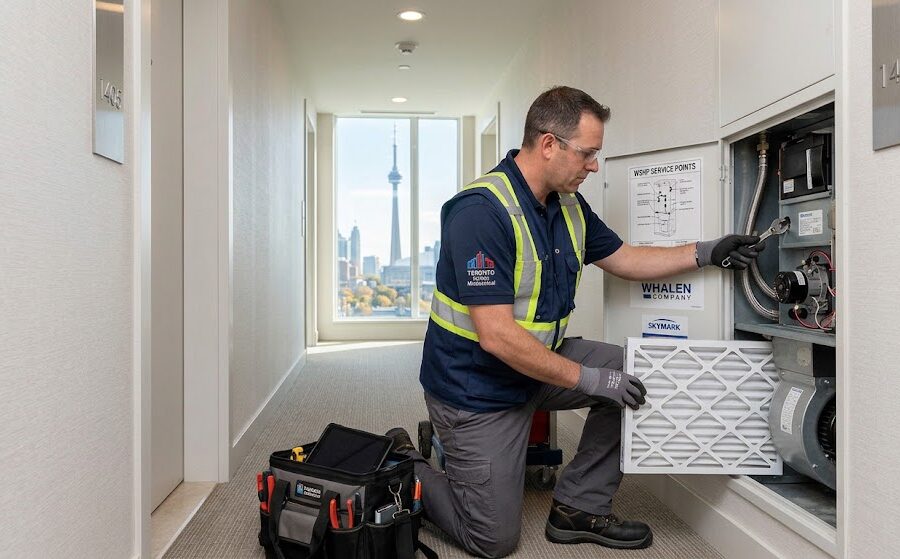
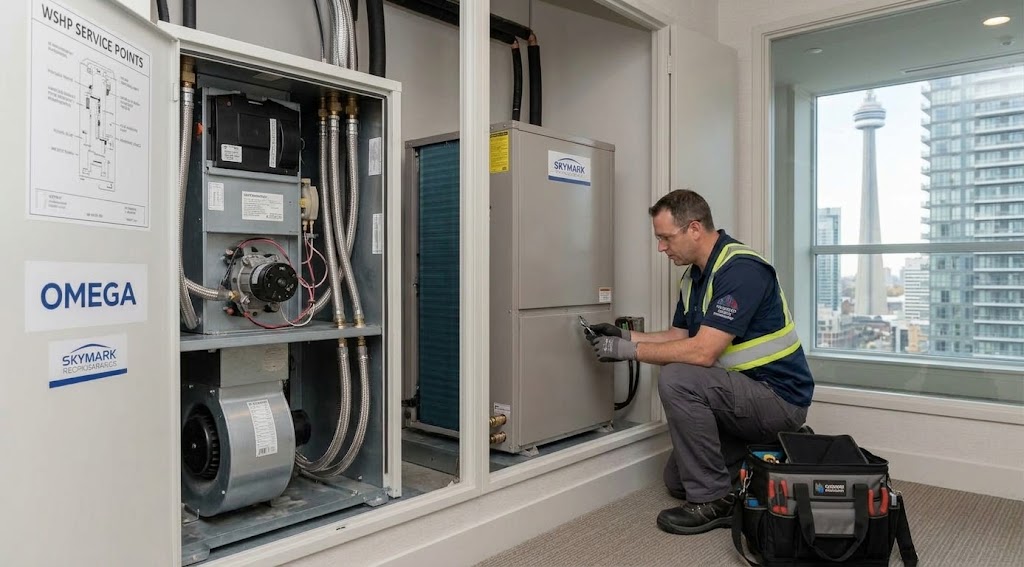
These are extremely common in the vast majority of high-rise towers across Downtown Toronto, North York, and Mississauga. These vertical stack or horizontal units (from manufacturers like Skymark, Omega, Whalen, and ClimateMaster) use a building-wide water loop to transfer heat. They connect to this central loop via flexible hoses and require a consistent flow of water to operate.
2. Magic-Pak All-In-One Thru-The-Wall Systems
These are typically found in mid-rise developments and multi-family residential communities. Magic-Pak units are completely self-contained, package systems that install through an exterior wall opening. They operate independently, using direct utility connections (electric cooling paired with either gas or electric heating), and do not connect to a central building water loop.
Magic-Pak vs. WSHP: A Comparison Guide
Understanding the pros and cons of each system type is essential when selecting a replacement model.
| Feature | Water-Source Heat Pump (WSHP) | Magic-Pak Thru-The-Wall |
| Operating Principle | Transfers heat via a building water loop. | Self-contained; uses direct utility power. |
| Typical Context | High-rise towers (downtown). | Mid-rise, townhomes, multi-family. |
| External Venting | None (internal closet). | Must vent through exterior wall. |
| Replacement Complexity | Moderate (requires loop connection care). | High (requires precise cabinet fitment). |
| Key Manufacturers | Skymark, Whalen, Omega, ClimateMaster. | Magic-Pak (M-Series, V-Series). |
Signs It’s Time for a Condo HVAC Upgrade in the GTA
Regardless of the system architecture your building uses, the indicators that a replacement is overdue remain the same:
Sudden Spikes in Monthly Energy Bills
As compressors age and internal coils become fouled, systems operate at much lower SEER and EER ratings. Older units work harder to achieve the same temperature setting, significantly increasing your energy footprint.
Increased Breakdown Frequency & Costly Repairs
If you are investing in frequent repairs—such as replacing failed start capacitors, contactors, or fan motors—your system may be signaling imminent end-of-life failure. Replacing the complete chassis is often the more cost-effective long-term investment.
Persistent Mechanical Noise and Vibration
Condo units are meant to be quiet. If you notice persistent high-pitched chirping, grinding from the blower fan, or excessive vibration upon startup, the mechanical bearings and mounts are degraded.